When faced with one or more missing teeth, most patients feel overwhelmed by their restoration options. Two of the most popular and proven solutions are dental implants and dental bridges—but which is right for you? The answer isn’t always straightforward. While dental implants offer superior longevity and bone preservation, dental bridges provide faster treatment and lower upfront costs. Understanding the critical differences between these two options will help you make an informed decision that aligns with your goals, budget, timeline, and overall oral health.
In this comprehensive guide, we’ll break down everything you need to know about dental implants versus bridges, including how each works, the pros and cons of each, cost considerations, maintenance requirements, and real-world scenarios where one option clearly outperforms the other. By the end, you’ll understand why both treatments remain essential tools in modern restorative dentistry—and which might be the best fit for your smile.
Understanding the Basics: What Are Dental Implants and Bridges?
Before diving into a detailed comparison, let’s establish what each solution is and how they fundamentally work.
What Is a Dental Implant?
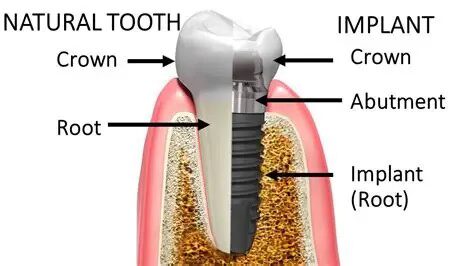
A dental implant is a permanent replacement for a missing tooth that restores both the crown (the visible part) and the root. The procedure involves surgically placing a titanium post directly into the jawbone, where it acts as an artificial tooth root. Over a healing period of 3–6 months, the implant undergoes a process called osseointegration, where the bone fuses with the titanium post, creating an incredibly stable and durable foundation.
Once osseointegration is complete, a custom crown (the visible restoration) is attached to the implant via an abutment, creating a restoration that looks, feels, and functions like a natural tooth.
Key characteristics of implants:
- Titanium post surgically placed in jawbone
- Requires osseointegration healing period (3–6 months)
- Separate implant needed for each missing tooth
- Custom crown attached to create natural appearance
- Functions independently without relying on adjacent teeth
What Is a Dental Bridge?
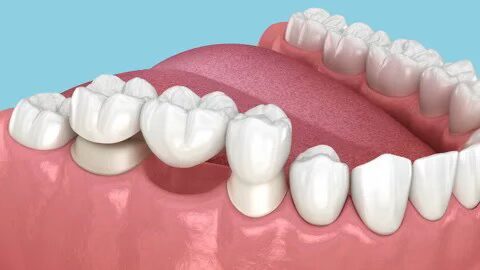
A dental bridge is a fixed prosthetic device that literally “bridges” the gap left by one or more missing teeth. Instead of replacing the tooth root, a bridge uses one or more surrounding natural teeth (called abutment teeth) as support. The restoration consists of crowns placed over the abutment teeth, which hold the fake tooth or teeth (called pontics) in place.
Key characteristics of bridges:
- Uses adjacent natural teeth for support
- Requires filing down healthy adjacent teeth
- Can replace one or more consecutive missing teeth
- No surgical procedure required
- Completed in 2–3 weeks with minimal downtime
Types of Dental Bridges
Understanding the different bridge options will help you determine if this restoration type is right for your situation.
Traditional Dental Bridge – The most common type, this bridge uses two abutment teeth, one on each side of the missing tooth or teeth. The replacement tooth (pontic) is suspended between two crowns. Traditional bridges are strong enough for any location in the mouth, including high-pressure molars.
Cantilever Dental Bridge – Used when there is a healthy tooth on only one side of the missing tooth. While this bridge saves a tooth from being prepared, it’s weaker than traditional bridges due to uneven force distribution and is typically used only for front teeth.
Maryland Bonded Bridge (Resin-Bonded Bridge) – This conservative option bonds to the back of adjacent teeth using a metal or porcelain framework, without requiring crowns. Maryland bridges preserve more of the adjacent teeth but are suitable only for front teeth and cannot handle the biting forces of molars.
Implant-Supported Bridge – For multiple missing teeth, implants can be strategically placed at the endpoints of a gap, with a bridge suspended between them. This combines the benefits of implants (bone preservation, no damage to adjacent teeth) with the ability to replace multiple consecutive teeth. Research shows implant-supported bridges have a cumulative prosthetic survival rate of 98.8%.
Longevity and Durability: Which Lasts Longer?
When evaluating any tooth replacement, longevity is a primary consideration—and this is where dental implants have a significant advantage.
How Long Do Dental Implants Last?
Dental implants are the most durable tooth replacement option available today. With proper care and maintenance, many implants last 20–25 years or longer—and some patients report lifetime success. Recent research shows that implants have survival rates of 95–98% over 10 years, making them one of the most reliable dental treatments.
Studies examining 20-year implant survival data show an impressive 4 out of 5 implants remain successful long-term. The titanium implant post itself typically lasts a lifetime, though the crown on top may need replacement after 10–15 years due to wear or cosmetic wear.
10-year implant survival rates:
How Long Do Dental Bridges Last?
Dental bridges have a significantly shorter lifespan than implants. Most bridges last between 7–15 years before requiring replacement or significant repair. Some sources cite an average of 10–12 years.
Why the shorter lifespan? Bridges can fail for several reasons:
- Decay on abutment teeth – The teeth supporting the bridge can develop decay beneath the crowns, requiring the entire bridge to be removed and replaced
- Cement deterioration – The cement bonding the bridge to the abutment teeth can break down over time
- Loose or broken bridges – The bridge itself may crack or become loose due to the stress of chewing forces concentrated on one or two supporting teeth
Research comparing implant and bridge survival rates shows that implants have a 94–98% survival rate after 10 years, while bridges have a 72–87% survival rate over the same period.
Bone Health and Preservation: A Critical Difference
One of the most important—but often overlooked—differences between implants and bridges is their impact on jawbone health. This is where implants have a profound advantage.
Why Bone Loss Matters
When a tooth is lost, the underlying jawbone loses the stimulation it receives from chewing forces. Without this stimulation, the body begins to resorb (break down) the bone in that area—a natural but damaging process.
The extent of bone loss is significant: within the first 6 months after tooth loss, patients can lose up to 25% of jawbone, and this increases to 45–60% within the first year. Over a lifetime, significant bone resorption can occur, leading to:
- Facial collapse and premature aging
- Difficulty with future tooth replacements
- Speech and chewing problems
- Shifting or instability of remaining teeth
How Implants Preserve Bone
Dental implants prevent bone loss by replacing the tooth root with a titanium post that transmits chewing forces directly into the jawbone. This stimulation signals the body to maintain and regenerate bone in that area.
Because implants stimulate the bone consistently, patients who choose implants maintain their bone density and facial structure.
Bridges and Bone Loss
Here’s the critical limitation of dental bridges: they do not replace the tooth root, only the visible crown. Because the bridge doesn’t transmit chewing forces to the underlying bone, the bone beneath the missing tooth continues to resorb over time.
As this bone loss progresses, several problems emerge:
- Gum recession – The gums recede, creating a visible dark gap between the gum and the artificial tooth
- Poor fit – The bridge becomes loose or ill-fitting, requiring adjustments or replacement
- Increased decay risk – Gaps trap food and bacteria, leading to decay of the abutment teeth and the tissues beneath the bridge
- Facial changes – Significant bone loss can lead to sunken cheeks, thin lips, and premature aging
Implant-supported bridges partially address this issue by using implants at the endpoints to stimulate the bone, though some bone resorption may still occur under the middle section of the bridge.
Impact on Adjacent Teeth: Preservation vs. Damage
Another crucial consideration is how each restoration option affects the teeth surrounding the gap.
Implants: No Impact on Adjacent Teeth
Dental implants are freestanding restorations that function independently without relying on neighboring teeth for support. Because the implant replaces the tooth root directly in the bone, healthy adjacent teeth are left completely untouched.
This means:
- No healthy teeth need to be filed down
- Enamel and underlying tooth structure remain intact
- Adjacent teeth maintain their longevity and natural function
- No additional stress is placed on neighboring teeth
For patients who prioritize preserving their remaining natural teeth, this is a compelling advantage of implants.
Bridges: Permanent Alteration of Healthy Teeth
Dental bridges require grinding down healthy abutment teeth to accommodate the crowns that hold the bridge in place. This is a permanent, irreversible process that removes tooth structure.
The consequences of this procedure include:
- Enamel removal – The outer protective layer of the tooth is permanently removed
- Increased sensitivity – Exposed tooth structure can become sensitive to temperature and pressure
- Higher decay risk – The reduced tooth structure is more vulnerable to decay, especially where the crown margin meets the tooth
- Potential root canal need – Over time, the tooth may require endodontic treatment (root canal) due to decay or pulp damage
This is why Maryland bonded bridges, which involve minimal or no tooth preparation, are sometimes preferred for front teeth—they preserve more natural structure compared to traditional bridges.
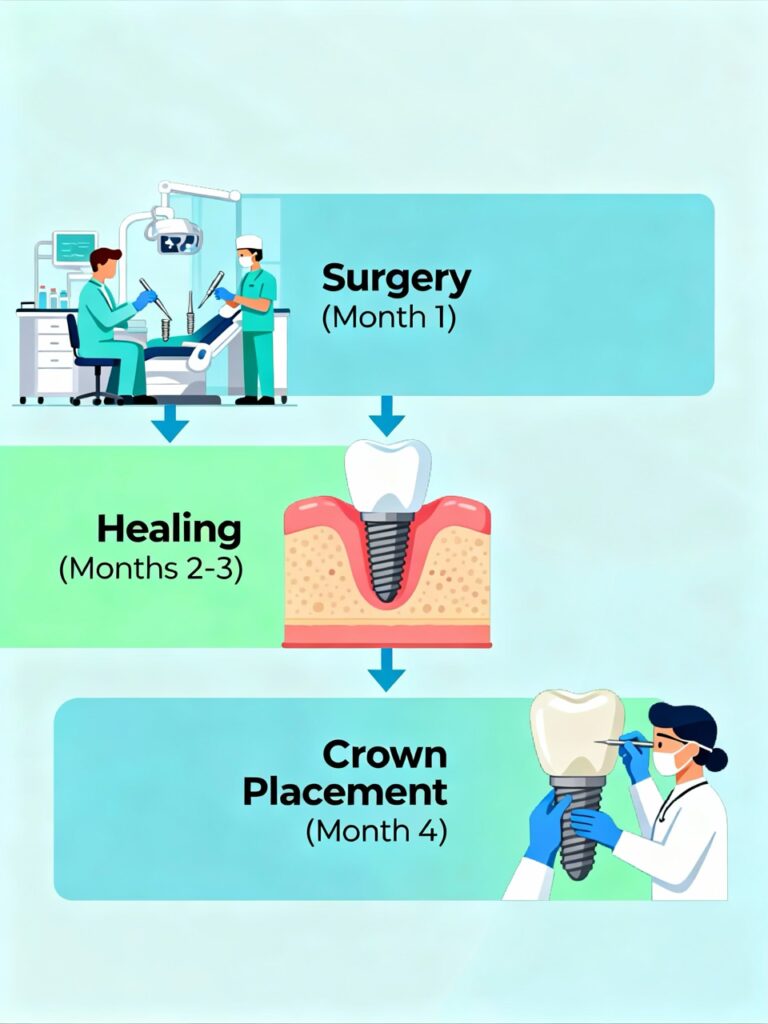
Treatment Timeline: Patience vs. Speed
Your personal timeline is an important factor in your decision.
Dental Implant Timeline
The complete implant process typically takes 3–6 months from start to finish, though some cases may extend to 9 months if bone grafting is needed.
Timeline breakdown:
- Initial consultation and imaging – 1–2 weeks
- Implant placement surgery – Single appointment
- Osseointegration healing period – 3–6 months
- Abutment placement and impression – 1 appointment
- Crown placement – 1–2 weeks after impression (1 appointment)
Total active appointments: 3–5
Total treatment time: 3–6 months
Dental Bridge Timeline
Bridges are significantly faster. The complete process typically takes 2–3 weeks, often completed in just 2–3 dental appointments.
Timeline breakdown:
- Consultation and treatment planning – Initial visit
- Examination and impressions to plan the bridge design
- Tooth preparation and temporization – First appointment
- Adjacent teeth are filed down to accommodate crowns
- A temporary bridge is placed while the final restoration is fabricated (usually 1–2 weeks)
- Bridge placement – Second appointment (1–2 weeks later)
Total active appointments: 2–3
Total treatment time: 2–3 weeks
Timeline Comparison:
| Phase | Implants | Bridges |
|---|---|---|
| Planning & Imaging | 1–2 weeks | 1–2 days |
| Treatment appointments | 3–5 visits | 2–3 visits |
| Healing/Fabrication time | 3–6 months | 1–2 weeks |
| Total time to completion | 3–6 months | 2–3 weeks |
For patients who need to restore their smile quickly—perhaps due to an upcoming event or time-sensitive job situation—bridges clearly offer the advantage.
Implant Success Rates and Candidacy Requirements
While implants offer excellent long-term outcomes, not all patients are candidates, and success depends on several factors.
Implant Success Rates
The data on implant success is compelling: overall dental implant success rates range from 95–98% over a 10-year period. This means that out of 100 implants placed, approximately 95–98 remain functional after 10 years.
Success rates vary slightly by location:
- Upper jaw implants: ~90–95% success after 10 years
- Lower jaw implants: ~95%+ success after 10 years
Long-term 20-year data shows a mean survival rate of 92% (dropping to 78% with careful statistical analysis), reflecting that about 4 out of 5 implants placed successfully endure for 20+ years.
Who Is a Good Candidate for Implants?
Ideal candidates for dental implants typically share several characteristics:
General health requirements:
- Good overall health without uncontrolled chronic conditions
- No uncontrolled diabetes, autoimmune diseases, or conditions that significantly slow healing
- Not currently undergoing chemotherapy or radiation
- Non-smoker or willing to quit smoking during healing (smoking reduces success rates)
Oral health requirements:
- Healthy gums with no active periodontal disease
- Sufficient jawbone density and volume to support the implant
- Excellent oral hygiene habits and commitment to maintenance
Anatomical requirements:
- Adequate bone in the desired implant location (at least 10mm of bone height and 5mm of width)
- Proper spacing from adjacent teeth and anatomical structures
Bone Grafting: Expanding Your Options
If a patient lacks sufficient bone density, bone grafting can create the foundation needed for implant placement. Grafting materials come from the patient’s own bone, donor bone, or synthetic options and require 3–6 months of healing before implant placement.
While bone grafting adds cost ($500–$3,000+) and time, it allows many patients who would otherwise be ineligible for implants to pursue this superior option.
When Implants May Not Be Ideal
Certain situations make bridges a better choice than implants:
- Insufficient bone density – Without bone grafting (cost/time constraints)
- Uncontrolled diabetes or autoimmune disease – Healing complications increase
- Heavy smoking – Significantly reduces implant success rates
- Health conditions affecting healing – Leukemia, autoimmune disorders
- Recent head/neck radiation – Healing may be compromised
- Multiple consecutive missing teeth – Implant-supported bridges may be more practical than individual implants
Common Mistakes and Myths About Implants and Bridges
Implant Myths Debunked
Myth #1: “Implants fail frequently”
Reality: Implant success rates of 95–98% over 10 years are among the highest for any dental procedure.
Myth #2: “Implants hurt and recovery is agonizing”
Reality: Most patients report minimal discomfort during surgery (performed under anesthesia) and manageable post-operative discomfort controlled with over-the-counter pain medication.
Myth #3: “Implants require special food restrictions forever”
Reality: Once healed, implants function like natural teeth and support a normal diet. Avoid excessive force during the 3–6 month healing period, but no permanent restrictions exist.
Myth #4: “Implants will set off metal detectors at airports”
Reality: Titanium implants do not trigger metal detectors. Only very old metal implants (rarely used today) might cause issues.
Bridge Myths Debunked
Myth #1: “Bridges are just as good as implants long-term”
Reality: While bridges are effective, implants have superior longevity (20–25 years vs. 7–15 years) and preserve bone.
Myth #2: “Bridges don’t require any maintenance”
Reality: Bridges require special cleaning techniques (floss threaders or water flossers) to remove plaque beneath the pontic, and failure to maintain proper hygiene can lead to decay and failure.
Myth #3: “A bridge is a permanent solution”
Reality: Bridges typically last only 7–15 years and often require replacement or significant repair.
Real-World Scenarios: Which Option Is Best?
Decision-making is easiest when you understand specific clinical scenarios where one option clearly outshines the other.
Scenario 1: Single Missing Tooth
Best choice: Dental Implant
For a single missing tooth, implants are often the superior choice because:
- No healthy teeth are damaged in the process
- Long-term longevity (20–25 years vs. 7–15 years for a bridge)
- Bone preservation prevents facial changes
- Functions independently without affecting adjacent teeth
Exception: If the patient lacks bone density and cannot afford bone grafting, a bridge becomes a reasonable alternative.
Scenario 2: Multiple Consecutive Missing Teeth
Best choice: Implant-Supported Bridge
For multiple consecutive missing teeth, the optimal solution combines the benefits of both technologies:
- Implants are placed at strategic points (typically at the ends and possibly middle of the gap)
- A bridge spans between the implants
- This preserves adjacent natural teeth and stimulates bone
- Success rate: 98.8% prosthetic survival
Alternative: A traditional bridge if the patient has healthy abutment teeth and cannot afford implants, though it requires grinding of healthy teeth and won’t preserve bone.
Scenario 3: Patient with Limited Budget and Healthy Adjacent Teeth
Best choice: Dental Bridge (short-term)
Long-term recommendation: Upgrade to implants
When budget is the primary constraint and adjacent teeth are healthy:
- A bridge offers immediate restoration at lower cost ($2,000–$4,000 vs. $3,500–$5,500)
- The bridge may be replaced with implants in the future as finances improve
- This bridges the gap (literally) between immediate need and long-term ideal solution
Maintenance and Oral Hygiene: What’s Required?
Both implants and bridges require different maintenance approaches.
Caring for Dental Implants
Implants are remarkably low-maintenance but demand meticulous oral hygiene:
Daily care:
- Brush around the implant crown like a natural tooth using a soft-bristled toothbrush
- Floss once daily using traditional floss or implant-specific floss
- Consider a water flosser for thorough cleaning
Professional care:
- Professional cleaning every 6 months (more frequently if you have a history of gum disease)
- Annual x-rays to monitor bone levels
Avoid:
- Smoking (increases implant failure risk)
- Chewing on ice, hard candy, or other extremely hard objects
- Tobacco and other irritants that can compromise gum health
Failure rate with proper care: Less than 5% after 10 years.
Caring for Dental Bridges
Bridges demand more specialized cleaning techniques:
Daily care:
- Brush the bridge and abutment teeth normally
- Use a floss threader to clean under the pontic (the fake tooth) since traditional floss cannot access this area
- Alternatively, use a water flosser or interproximal brush
Professional care:
Common challenges:
- Poor cleaning under the bridge increases decay risk significantly
- The bridge is more difficult to clean than implants
- Abutment teeth are more vulnerable to decay despite bridges’ lower cost
Maintenance comparison: Bridges require more vigilant daily care and are at higher risk of failure if oral hygiene is compromised.
Why Choose Today’s Dental for Your Implant or Bridge Consultation?
Today’s Dental in Pinellas Park is a trusted, family-owned practice committed to providing comprehensive restorative dentistry solutions. Whether you’re considering an implant or bridge, our experienced team takes time to:
- Perform thorough examinations with advanced 3D imaging to assess your bone structure and overall oral health
- Discuss both options in detail, explaining the pros, cons, costs, and timelines for your specific situation
- Create customized treatment plans that prioritize your goals, timeline, and budget
- Provide expert surgical placement for implants using the latest techniques
- Ensure comfortable, successful healing and restorations
Our patient-centered approach means you’re never pressured into a decision. We’ll help you understand which solution offers the best long-term value for your unique circumstances.
Frequently Asked Questions
Where is the best place to get dental implants in Pinellas Park, FL?
If you are looking for high-quality dental implants in Pinellas Park, FL, Today’s Dental offers advanced implant solutions with a focus on long-term function, comfort, and aesthetics under the care of Dr. Korey. You can learn more about the process and benefits on Dr. Korey’s dental implants page.
Which is better, a dental implant or a bridge?
Neither is universally “better”—it depends on your specific situation. Implants offer superior longevity (20–25 years), preserve bone, and don’t damage adjacent teeth, but cost more upfront and require surgery. Bridges are faster (2–3 weeks), less expensive initially ($2,000–$4,000), and don’t require surgery, but last only 7–15 years and damage adjacent healthy teeth. For a single tooth with adequate bone and budget, implants typically provide better long-term value. For multiple teeth or limited budget, bridges may be more practical.
How long does a dental implant last?
How long does a dental bridge last?
Do implants hurt?
Can everyone get a dental implant?
Not everyone is an ideal candidate. You need sufficient jawbone density, healthy gums, and good overall health. However, bone grafting can create the foundation if you lack adequate bone. Certain health conditions (uncontrolled diabetes, autoimmune diseases) or smoking may disqualify you or reduce success rates.
What’s the difference between a dental bridge and an implant-supported bridge?
Can I get an implant if I don’t have enough bone?
Which option is more cost-effective long-term?
Do I need special care for implants or bridges?
How do implants affect jawbone health compared to bridges?
Implants stimulate the jawbone, preventing bone loss and maintaining facial structure. Bridges do not replace the tooth root, so the jawbone beneath the missing tooth continues to resorb at a rate of 25% within 6 months and 45–60% within a year. This is a major advantage of implants.